Science is the acquisition of knowledge through systematic study of the natural world. Theology is the study of God and religious faith. Are science and theology friends, enemies, or strangers? This is a very important question and affects how one views the myriad of issues related to science and theology. The first question that needs to be answered is whether science and theology intersect at all. If science and theology do not interact they are strangers. This can be viewed as two nonintersecting circles.

This has been called the independence model. This model says that science and theology occupy completely separate domains of knowledge that do not interact. Stephen J. Gould popularized this model as NOMA, non-overlapping magisteria. Gould reasoned that when science and theology stay within their respective domains they can coexist peacefully. Then in 1999, the National Academy of Sciences published Science and Creationism that stated that “Scientists, like many others, are touched with awe at the order and complexity of nature. Indeed, many scientists are deeply religious. But science and religion occupy two separate realms of human experience. Demanding that they be combined detracts from the glory of each.” The independence model has been criticized by both the religious and atheist alike and it will find no support in this blog. The independence model is a cheap attempt to marginalize theology. It is disingenuous. The NAS is looking for a way not to offend the vast majority of the public that believes in God but does not believe that the natural world is an accident.
In order for science and theology to be friends or enemies they must intersect. One can view the interaction as two intersecting circles.
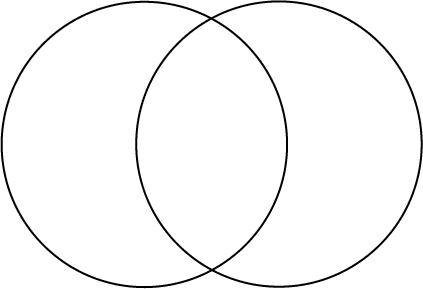
There are elements of science that do not directly involve our study of God.

There are elements of theology that do not directly involve the study of the natural world.
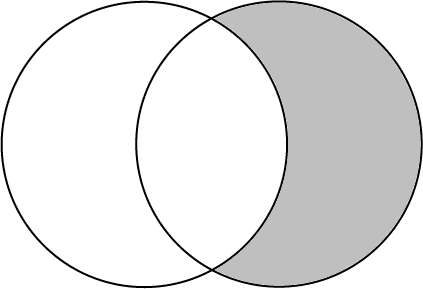
But if science and theology are friends or enemies they interact in some areas.
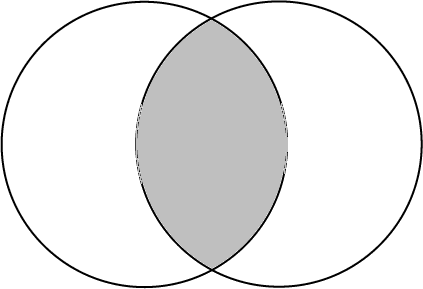
What are we to make to these areas of intersection? Some say that there can only be conflict in this area of intersection. This would mean that science and theology are enemies. Enemies hate one another. They are in conflict. Are science and theology in conflict? Well, sometimes…but always? Of course not. The conflict thesis was popularized in the 19th Century but has for the most part fallen out of favor among philosophers of science. The attitudes that contributed to the formation of the conflict thesis remain however. It does not help that the religious establishment (whatever that means) is hesitant to incorporate new scientific discoveries into current biblical interpretation.
I think science and theology are friends. There are many areas of agreement between science and theology. This is science apologetics. [More on this in future posts.] But there are also some areas of apparent conflict. [More on this in the future as well.] What is often forgotten is that there is interpretation needed in both science and theology. Science requires interpretation of data from the physical world. Biblical theology requires interpretation of the Bible. Romans 1 says that we learn about the nature of God from the natural world. Thus, if God speaks to us through the Bible and He tells us about Himself through the natural world, and if God cannot lie (a given), then any conflict at the intersection of science and theology must be APPARENT conflict. Apparent conflict means that there is either a misinterpretation of scientific data or a misinterpretation of the Bible…or both.
Yes…science and theology ARE friends. But sometimes friends don’t see eye to eye. Sometimes friends argue. Sometimes the arguments get loud. But friends work out their differences through respect and dialogue.
 Pleochroism
Leave a comment